There is a particular kind of chaos that descends upon a household in late summer. The lazy, sun-drenched rhythm of vacation dissolves almost overnight, replaced by the urgent drumbeat of school supply lists, rearranged schedules, new extracurriculars, and the quiet realization that your own professional life needs to snap back into focus as well. Backpacks appear on kitchen counters. Permission slips multiply on the dining table. Lunches need packing, outfits need planning, and somewhere in the middle of it all, you still have emails to answer, meetings to prepare for, and a business to run.
If this sounds like your September, you are far from alone. At Swoon Spaces, the back-to-school season is one of our busiest periods. Families across New York City, Los Angeles, and Austin reach out because they feel the same thing: the systems that carried them through summer are no longer enough. The home that felt spacious and relaxed in July suddenly feels like it is working against them. And the truth is, it probably is, because the demands of a school-year household are fundamentally different from a summer one, and the organizational infrastructure needs to shift accordingly.
This is not about buying matching bins and calling it a day. This is about designing thoughtful systems that honor the real complexity of modern family life, where parents are simultaneously CEOs of their households and leaders in their professional worlds, and where children deserve to develop their own sense of responsibility and independence. When the home runs smoothly, everything else follows.
Why the Back-to-School Transition Feels So Overwhelming
Before we dive into solutions, it is worth understanding why this particular seasonal shift creates such intense pressure. Summer operates on a forgiving timeline. Mornings are slow, bedtimes are flexible, and the consequence of forgetting something is usually minor. The school year, by contrast, is a precision operation. A misplaced homework folder can derail a morning. A forgotten lunch means a hungry, distracted child. A cluttered home office means a parent who starts every workday already behind.
The overwhelm stems from the sheer number of simultaneous transitions happening at once. Children are adjusting to new teachers, new classmates, and new academic demands. Parents are recalibrating their own work schedules around school hours, pickup times, and extracurricular commitments. The household itself must accommodate new routines for mornings, evenings, meals, and weekends. When none of these transitions have dedicated systems to support them, every day feels like improvisation, and improvisation is exhausting.
"The most successful families we work with do not have more time or more space. They have better systems. And those systems are always built before the chaos begins, not in the middle of it."
The Family Command Center: Your Household's Control Room
If there is one organizational investment that transforms the back-to-school experience more than any other, it is the family command center. This is a dedicated area of your home, typically near the main entrance or in the kitchen, that serves as the central hub for everything your family needs to navigate the day. Think of it as the control room of a well-run household.
A thoughtfully designed command center includes several key components, each serving a distinct purpose:
- A family calendar: Whether wall-mounted or digital displayed on a tablet, this calendar should show every family member's schedule at a glance. Color-code by person. Include school events, extracurricular activities, work deadlines, appointments, and social commitments. When everyone can see the week ahead, the daily question of "what is happening today" disappears entirely.
- Individual landing zones: Each family member needs a designated spot for their daily essentials. For children, this means a hook for their backpack, a bin or cubby for their shoes, and a small tray for items that travel between home and school: library books, permission slips, sports equipment. For adults, a charging station, a key hook, and a mail sorter keep the essentials from scattering across the house.
- A paper management station: School generates an astonishing volume of paper. Without a system, it ends up in piles on every flat surface. Install a simple wall-mounted file sorter with sections labeled "action required," "to sign and return," and "to file or recycle." Process this station every evening and it will never overflow.
- A meal planning board: A small whiteboard or chalkboard dedicated to the week's dinner plan and lunch rotation eliminates the nightly question of what to eat. Pair it with a magnetic grocery list and you have cut your meal-related decision fatigue in half.
The beauty of a command center is not just its functionality, but the calm it creates. When every item has a home and every task has a system, the mental load that parents, particularly mothers, carry becomes dramatically lighter. You stop holding everything in your head because the house itself is holding it for you.
Morning Routines: Designing Systems That Run Themselves
The morning hours of a school-year household are the ultimate stress test for any organizational system. Everything must happen in sequence, on time, and with minimal friction. The families who navigate mornings with grace are not simply more disciplined. They have invested in systems that reduce the number of decisions required before anyone has fully woken up.
The Night-Before Ritual
The secret to a smooth morning is that it actually begins the evening before. We teach every family we work with a fifteen-minute nightly ritual that eliminates at least eighty percent of morning chaos:
- Pack backpacks completely: Homework, folders, signed forms, water bottles, and any special items for the next day go into backpacks and are placed on their designated hooks. Nothing should need to be added in the morning.
- Set out clothing: Children choose and lay out their full outfit for the next day, including shoes, socks, and outerwear. For younger children, a five-compartment hanging organizer labeled Monday through Friday allows you to plan an entire week of outfits on Sunday evening.
- Prep lunches: Assemble as much of the next day's lunches as possible. Pre-portioned snacks, filled water bottles, and prepped sandwiches stored in labeled containers make morning lunch packing a two-minute task rather than a fifteen-minute scramble.
- Review the calendar: A quick family check-in on what tomorrow holds. Does anyone have an early meeting? A field trip? An after-school activity that requires special gear? Knowing these things at night means no surprises at seven in the morning.
The Visual Routine Chart
For children, especially those under ten, a visual routine chart posted in their bedroom or bathroom transforms the morning from a series of parental reminders into an exercise in independence. List each morning task with a simple illustration or photograph: wake up, make bed, get dressed, eat breakfast, brush teeth, put on shoes, grab backpack. Children who can follow a visual sequence feel empowered rather than nagged, and parents reclaim the energy they were spending on constant redirection.
Reclaiming Your Professional Focus: The Workspace Reset
Here is the part of the back-to-school conversation that rarely gets discussed: the parents. Specifically, the professional lives of parents who have spent the summer in a looser working rhythm, perhaps with children at home, perhaps with a more relaxed schedule, and who now need to shift back into full professional mode.
At Swoon Spaces, we see this every year. The home office that functioned well enough during the summer, with its growing stack of papers and its desktop covered in notes, suddenly needs to perform at a higher level. The dining table that doubled as a workspace needs to return to its primary purpose. The creative energy that was flowing freely all summer now needs to be channeled and structured.
The Professional Reset Checklist
We recommend a dedicated workspace reset at the start of the school year, treating it with the same intentionality you would bring to organizing a new office:
- Clear and clean every surface: Remove everything from your desk, shelves, and any other work surfaces. Wipe them down. Only return items that are essential to your current projects and daily workflow. Summer's accumulated clutter, the conference brochures, the vacation receipts, the half-read books, all need to be processed and put away or discarded.
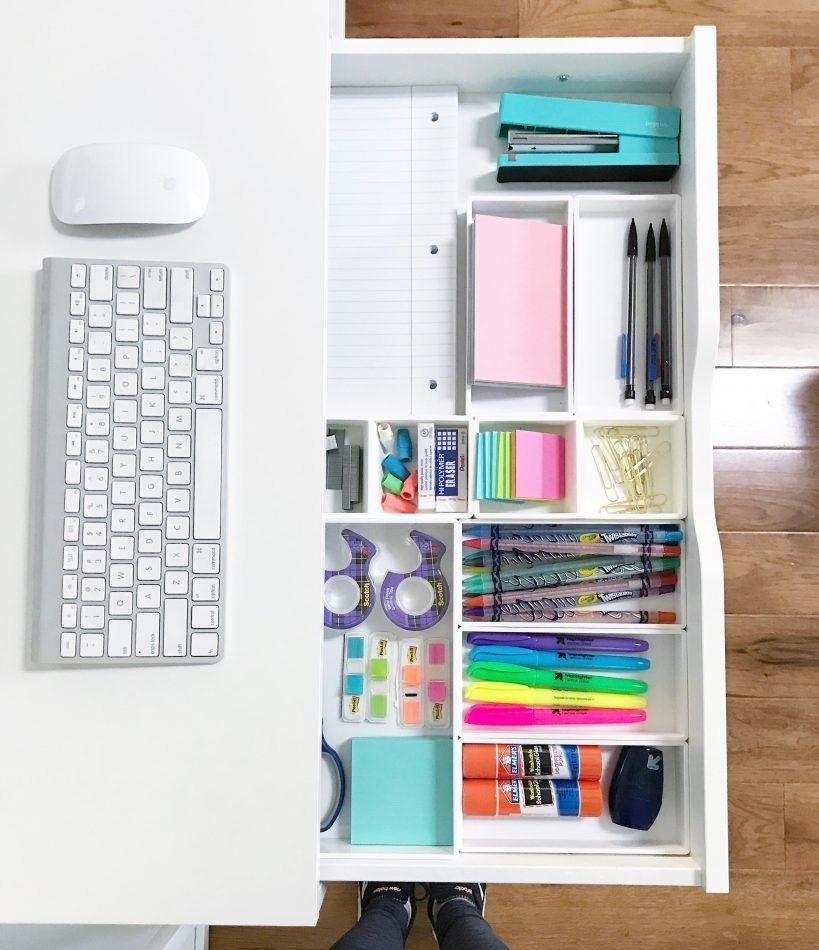
- Audit your supplies: Replenish printer paper, ink cartridges, notebooks, and pens. Discard dried-out markers and pens that no longer work. Organize your supplies into clearly labeled containers so you never interrupt a workflow to hunt for a stapler.
- Reorganize your digital workspace: Clear your computer desktop, archive completed project files, organize your email folders, and update your task management system. A cluttered digital environment creates the same cognitive drag as a cluttered physical one.
- Define your new schedule: With school hours dictating a new framework for your day, map out your ideal work blocks. When are your focus hours? When do you handle calls and meetings? When do you step away for school pickup or activities? Writing this schedule down and posting it in your workspace turns intention into commitment.
"Your home office should transition with the same purpose and care as your children's backpacks. Both spaces need to be ready to perform at their best when the new season begins."
The Mudroom and Entryway: Where Organization Begins and Ends
Every school day begins and ends at the door, which makes your entryway or mudroom the single most important organizational space in a family home during the school year. If this area is chaotic, it will set the tone for every departure and arrival. If it is calm and functional, it becomes the bridge between the peace of your home and the energy of the outside world.
The essentials for a school-year entryway are straightforward but non-negotiable:
- One hook per person mounted at an accessible height for each family member. Backpacks, coats, and bags should never touch the floor.
- A shoe system that contains footwear rather than allowing it to sprawl. A low bench with cubbies beneath it serves double duty: somewhere to sit while putting on shoes, and somewhere for each pair to live when they come off.
- A catch-all tray for items that come home in pockets and hands: keys, sunglasses, loose change, notes from teachers. Without this, these items will end up scattered across kitchen counters and coffee tables.
- An outbox for items that need to leave the house: library books to return, packages to mail, dry cleaning to drop off. Placing these by the door means they actually make it out of the house instead of sitting on a counter for two weeks.
Involving Children in the Process
One of the most important and frequently overlooked aspects of back-to-school organization is involving the children themselves. When children participate in designing and maintaining organizational systems, they develop executive functioning skills, a sense of ownership over their space, and habits that will serve them for the rest of their lives.
This does not mean handing a seven-year-old a label maker and hoping for the best. It means guiding them through age-appropriate decisions. Let a young child choose the color of their backpack hook or the design of their routine chart. Invite an older child to help sort through their desk supplies and decide what they need for the new year. Ask a teenager to organize their own study space and then coach them on systems that actually work rather than imposing your own preferences.
The goal is not perfection. It is participation. A child who understands why things have designated homes, who has had a say in where those homes are, and who experiences the daily satisfaction of a system that works, is a child who will carry those organizational instincts into adulthood. This is one of the most valuable gifts you can give them, and it costs nothing but a little patience and a willingness to let the process be collaborative rather than top-down.
Maintaining Momentum Through the School Year
The most beautifully organized home will revert to chaos without maintenance, and the school year presents unique maintenance challenges because the pace rarely lets up. Here is the rhythm we recommend for keeping your systems running smoothly from September through June:
- Daily (five minutes): The nightly ritual described above. Backpacks packed, outfits set, lunches prepped, calendar reviewed. This is non-negotiable and takes less time than one episode of a television show.
- Weekly (fifteen minutes): Sunday evening family meeting. Review the week ahead, update the command center calendar, plan meals, and process any accumulated paper. This is also the time to address anything that is not working. If the shoe cubby is overflowing, if the paper station is backed up, if the lunch routine is taking too long, troubleshoot it now rather than letting it fester.
- Monthly (one hour): A deeper organizational sweep. Rotate seasonal clothing, discard outgrown items, clean out backpacks and desk drawers, and refresh supplies. This monthly rhythm prevents the gradual accumulation that leads to the overwhelm most families feel by mid-October.
- Quarterly (half day): A mini reset aligned with the school calendar: beginning of school, winter break, spring break, and end of school. Each of these natural pauses is an opportunity to reassess what is working, donate items no longer needed, and refine your systems for the season ahead.
Your Family Deserves a Home That Works as Hard as You Do
The back-to-school transition does not have to be a season of stress and scrambling. With the right systems in place, it can be a season of fresh starts, renewed focus, and the quiet satisfaction of a household that hums along with purpose and ease. Your children head out the door with everything they need. You sit down at your desk with a clear mind and a clear workspace. The evenings are for connection rather than catching up on everything that fell through the cracks during the day.
This is what thoughtful organization makes possible. Not a picture-perfect home that exists for Instagram, but a living, breathing space that supports every member of your family in becoming their best, whether they are heading to the third grade or heading a company. At Swoon Spaces, we believe that every family deserves this, and we would love to help you build it.